
Building materials
D-PYRE® enhances the performance of building materials by providing built-in, non-toxic flame-retardant protection, without compromising strength, weight, or performance.

We have developed our own series of POSS-based materials - D-PYRE®- specifically designed to enhance the performance and safety of industrial building materials, such as foams and insulation, with non-toxic flame-retardant properties.
Flame-retardants that don’t compromise performance
Building materials like foams and insulation must meet strict flame-retardant standards-especially in construction, transportation, and energy-efficient architecture. But conventional flame retardants often compromise mechanical integrity, thermal stability, or processing performance.
With D-PYRE®, you get a flame-retardant additive that protects without compromise. Even at low loadings (as little as 1–2%), D-PYRE® delivers reliable fire resistance while preserving the structural and thermal properties of the material.
Key benefits of D-PYRE® in foams and insulation:
Non-toxic flame retardancy: Halogen-free and environmentally safe
Minimal loading required: Effective at just 1–2%, reducing cost and formulation complexity
Maintains material integrity – Preserves compressive strength, flexibility, and thermal insulation
Compatible with common resins – Works with polyurethane, polystyrene, phenolic, and other systems
Thermally stable – Performs reliably across a wide range of temperatures
Lightweight and efficient – Ideal for applications where performance and weight both matter
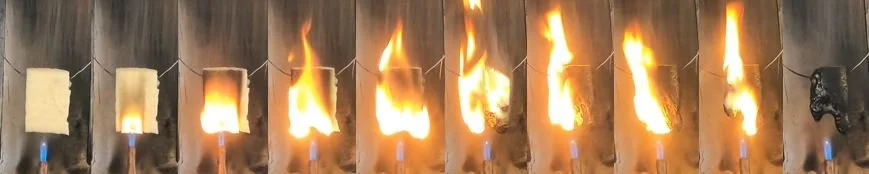
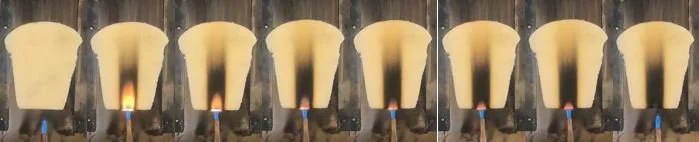
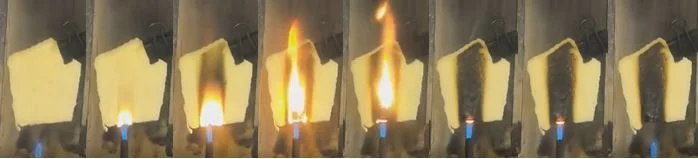
D-PYRE® in PU FOAM
Without FR additives
With standard FR additives
With 1.5% D-PYRE® and standard FR additives

Partner with us in developing non-toxic building materials!
Interested in testing our materials?
We are actively seeking research and development partners across automotive, electronics and construction sectors.
Contact us to collaborate on next generation, non toxic adhesive solutions.

Supporting SDG 11 and 12
Building materials enhanced with D-PYRE® particularly support SDG 11 by contributing to safer, more fire-resilient buildings and infrastructure, and SDG 12 by replacing hazardous flame retardants with non-toxic alternatives that support cleaner, more sustainable production practices.